The All-on-4 Conversation Nobody Is Having Honestly
"The best clinical decision is never the one that sounds the most impressive. It's the one that's actually right for you."
If you've been researching full arch implants in Brisbane, you've likely encountered some version of the same message repeated across every clinic website: All-on-4 is revolutionary, life-changing, available now, starting from a number that looks appealingly low until you read the fine print.
What you haven't encountered — or at least not often enough — is an honest conversation about whether All-on-4 is actually the right solution for your specific situation. Whether you're genuinely a candidate. What the procedure involves beyond the before-and-after photos. And what questions you should be asking before you agree to anything.
That's what this is.
What All-on-4 Actually Is
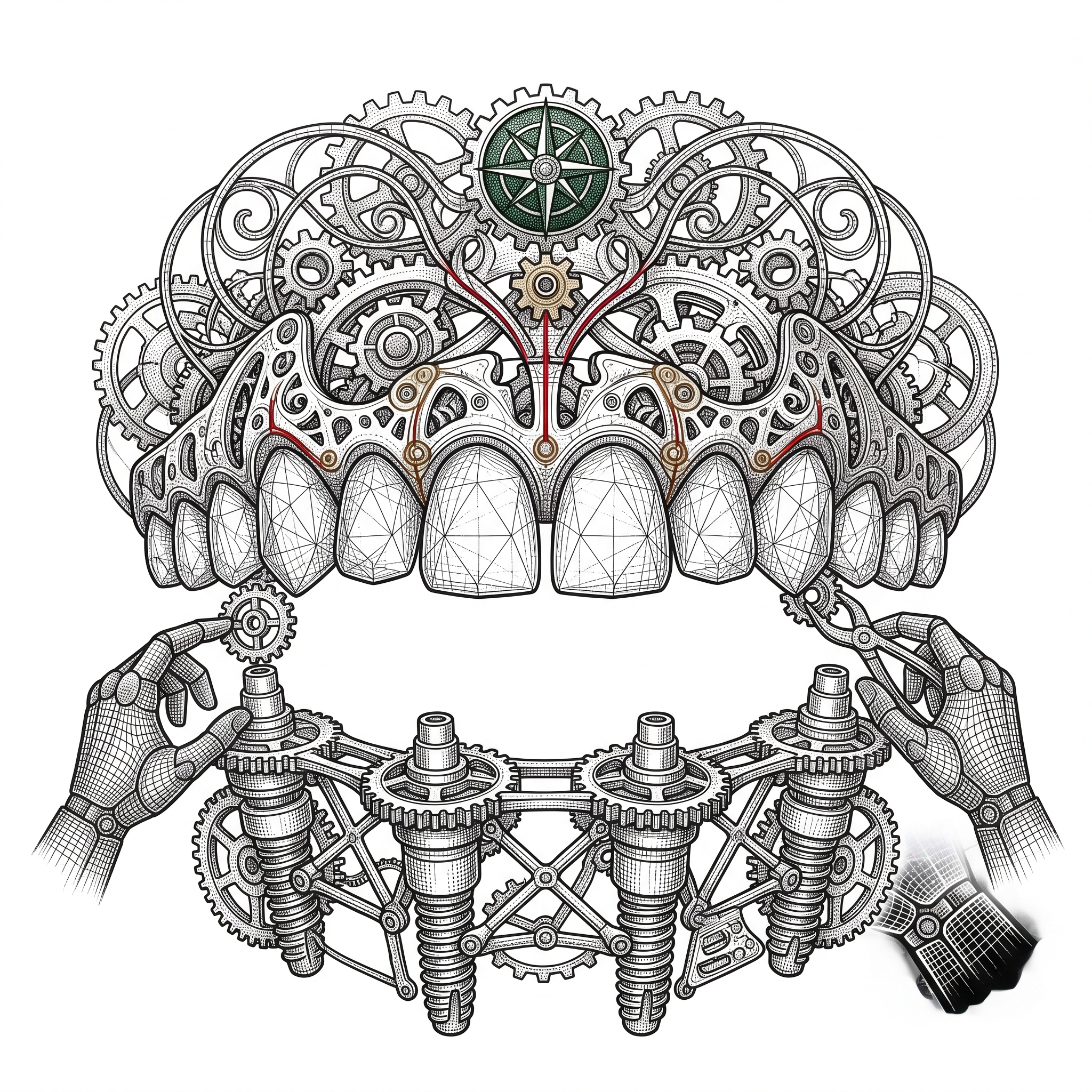
All-on-4 is a full arch tooth replacement system. Four titanium implants are placed into the jawbone — two at the front in a vertical position, two towards the back at an angle of approximately 45 degrees. A fixed prosthetic bridge is then attached to these four implants, replacing an entire arch of teeth.
The angled placement of the posterior implants is the engineering insight that makes the system work. By tilting the rear implants, the procedure is able to engage denser areas of bone further forward in the jaw — which means that in many cases, patients who would otherwise require bone grafting before implant placement can proceed without it. This reduces surgical complexity, reduces cost, and shortens the overall treatment timeline.
For the right patient, it is an elegant, well-evidenced solution with decades of clinical data behind it. For the wrong patient, it is a significant surgical procedure placed on a foundation that isn't appropriate for it.
The difference between those two outcomes almost entirely comes down to assessment.
Who Is Actually a Candidate
This is the conversation that tends to get glossed over in the rush toward booking.
Genuine candidacy for All-on-4 — or any full arch implant treatment in Brisbane — requires a thorough clinical assessment, not a phone consultation and a panoramic X-ray. The factors that determine whether you're suitable include:
Bone volume and density. While All-on-4 is specifically designed to work with reduced bone volume, there is a threshold below which even angled implants cannot achieve adequate primary stability. Severely resorbed ridges — typically seen in patients who have worn full dentures for many years without implant support — may require bone grafting, zygomatic implants, or a different surgical approach entirely. A CBCT scan, not a standard X-ray, is the only way to assess this accurately.
Systemic health. Certain medical conditions and medications significantly affect implant success rates. Uncontrolled diabetes impairs healing. Bisphosphonate medications — commonly prescribed for osteoporosis — affect bone metabolism in ways that complicate implant integration and increase the risk of a serious complication called osteonecrosis. Active cancer treatment, autoimmune conditions, and bleeding disorders all require careful consideration before surgery. A clinician who doesn't take a thorough medical history before proposing full arch implants is skipping a step that matters.
Smoking. The data on this is unambiguous. Smoking significantly increases implant failure rates by restricting blood supply to the surgical site and impairing healing. It doesn't make you automatically ineligible, but it is a material risk factor that should be discussed honestly — not minimised because a consultation has already been booked.
Occlusal factors. Patients who clench or grind heavily place substantially greater forces on implant-supported prosthetics than those who don't. This needs to be assessed and factored into the prosthetic design. A bridge designed without accounting for parafunctional habits is being set up for premature failure.
Gum tissue health. Active gum disease must be treated before implant placement. Placing implants into a mouth with uncontrolled periodontal infection is a predictable path to failure.
If a clinician has not assessed all of these factors before presenting you with a treatment plan and a price, you have received a quote, not a diagnosis.
The Questions Worth Asking Before You Commit
Patients considering full arch implants in the Newstead, Greenslopes, Paddington and broader Brisbane inner suburbs area often come to me having already attended one or two consultations elsewhere. The most common feedback I hear is that they left with a price and a start date, but without answers to the questions that actually mattered to them.
Here are the questions that matter:
What implant system are you using, and why? Premium implant systems — brands like Straumann, Nobel Biocare, and Astra Tech — have decades of peer-reviewed clinical data supporting their long-term performance. They cost more. They are worth understanding. If a clinic is not able to tell you the brand of implant being placed in your jaw, that is worth probing.
What does my CBCT scan show specifically? A cone beam CT scan provides a three-dimensional image of your bone volume, bone density, nerve positions, and sinus anatomy. This information directly determines where implants can be placed, at what angle, and of what dimensions. If you haven't had one, or if the findings haven't been explained to you in detail, the treatment plan is not yet complete.
What prosthetic material is included in the quoted price? There is a significant difference between an acrylic provisional bridge and a final zirconia prosthesis. Both have their place in the treatment sequence — but they are not the same thing, and a quote that includes only an acrylic bridge while presenting a zirconia-level aesthetic outcome in the marketing material is not being transparent with you. Ask specifically what the final prosthesis is made from, and what the additional cost is if you want zirconia.
What happens if an implant fails to integrate? Implant failure, while uncommon with good planning and surgical technique, does occur. Understanding the protocol — how it's identified, how it's managed, and what the financial implications are — tells you a great deal about how experienced a clinician is with complex cases and how honestly they're communicating with you.
Who is performing the surgery? In Australia, any registered dentist can legally place implants regardless of their level of specific training. This is not widely understood by patients. Asking directly about a clinician's experience with full arch cases — how many they've completed, what their protocol is for complex anatomy, whether they have specialist training — is entirely reasonable and should be welcomed, not deflected.
All-on-4 vs Other Full Arch Options
All-on-4 is the most widely marketed full arch solution, but it is not the only one. Depending on your anatomy and clinical situation, other approaches may be more appropriate.
All-on-6 uses six implants rather than four to support the full arch bridge. In patients with adequate bone volume, the additional implants distribute load more evenly and can provide greater long-term stability, particularly in the upper jaw where bone density is typically lower. It is a more conservative approach biomechanically, though it requires more bone to execute.
Zygomatic implants are used in cases of severe upper jaw bone loss where conventional implant placement — even with angling — is not feasible. Rather than anchoring in the jawbone, zygomatic implants anchor in the cheekbone. They require specialist surgical training and are used in specific anatomical situations, not as a routine alternative.
Individual implants remain the gold standard for patients who are missing only some teeth, or who have sufficient bone for a tooth-by-tooth approach. All-on-4 is specifically designed for full arch replacement — it is not the most appropriate solution for a patient missing four or five teeth with healthy remaining dentition.
The right answer depends entirely on what your specific anatomy and clinical situation calls for. A clinician who recommends the same solution to every patient presenting with missing teeth is not assessing you — they are running a protocol.
What Honest Treatment Planning Looks Like
In my practice, serving patients across Brisbane's inner north and south — including Newstead, Fortitude Valley, Greenslopes, Paddington, and surrounding suburbs — a full arch implant consultation involves several components before any treatment recommendation is made.
A comprehensive medical and dental history. A full clinical examination of existing teeth, gum tissue, bite, and jaw function. A CBCT scan to assess bone in three dimensions. A review of the scan findings with the patient, explaining exactly what is present and what it means for treatment options. A discussion of all viable approaches — not just one — with honest explanation of the advantages, limitations, and long-term maintenance requirements of each.
Only after all of that is a treatment plan presented. And that plan is taken home, considered, and discussed again before anything is signed or scheduled.
This is not a slow process for its own sake. It is the process that produces predictable, lasting outcomes — and that ensures you understand what you are agreeing to before surgery begins.
The Honest Summary on Cost
Full arch implant treatment in Brisbane ranges significantly in price depending on the implant system used, the prosthetic material, the complexity of your case, and what is actually included in the quoted figure.
A complete, well-planned All-on-4 case using a premium implant system with a final zirconia prosthesis sits at the higher end of the published ranges. A case quoted at the lower end of the market warrants careful scrutiny of what is and isn't included — whether the CBCT scan is additional, whether bone grafting is quoted separately, whether the price reflects a provisional acrylic bridge or the final prosthesis.
The most useful thing you can do when comparing quotes is ask each clinic for an itemised breakdown of every component. Compare complete costs, not headline numbers.
What I would caution against is making a decision about full arch surgery — an irreversible, surgically complex procedure — primarily on the basis of price. The cost of revision surgery, of managing a failing implant, of rebuilding a case that was planned incorrectly the first time, almost always exceeds the saving that seemed compelling at the outset.
If You're Considering This in Brisbane
The inner Brisbane suburbs — Newstead, Greenslopes, Paddington, Fortitude Valley, New Farm and surrounds — have access to a range of clinicians offering full arch implant treatment. The quality, the depth of planning, and the transparency of communication varies considerably between them.
What you deserve, regardless of where you go, is a clinician who takes the time to assess you properly, explains what they find, presents your options honestly, and answers your questions without pressure.
If you've had a consultation that didn't feel like that — where you left with a price but not a clear picture of your situation — a second opinion is not disloyal. It's sensible. And in the context of treatment this significant, it's exactly what I'd recommend.
A consultation at my practice begins with your scan, your history, and your questions — not a close. If you're researching full arch implants in Brisbane and want an honest assessment of where you stand, start there.